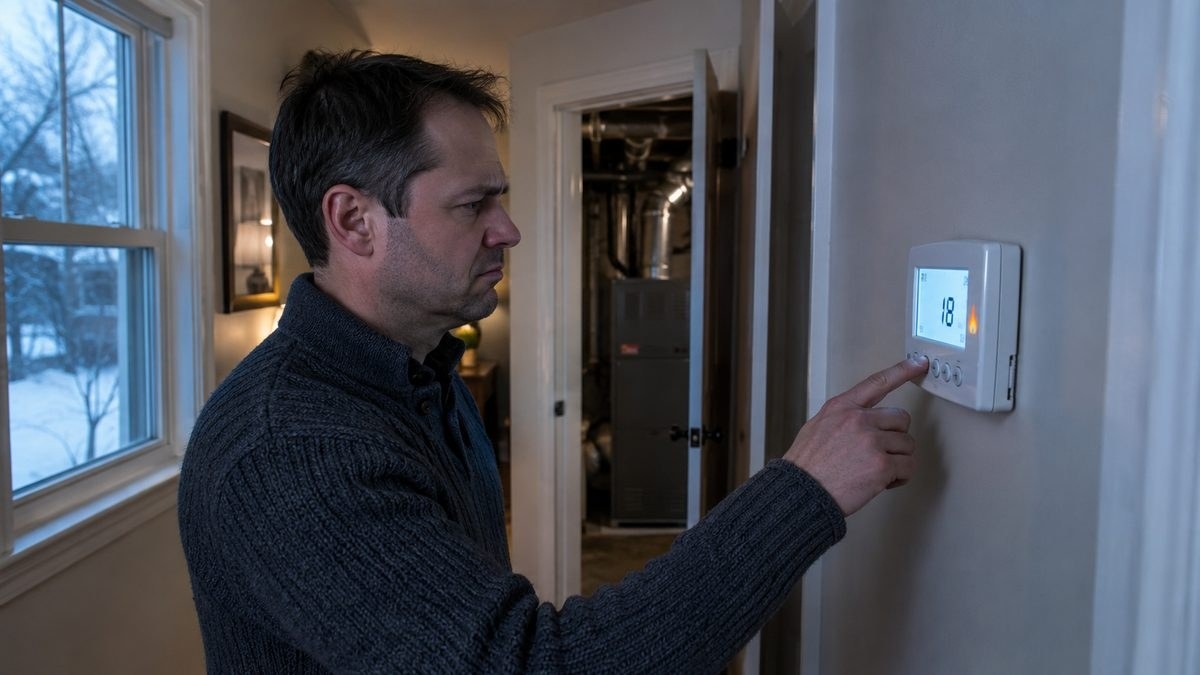
A furnace that will not start often has a problem outside the furnace itself: the thermostat is not requesting heat, a setting has changed, or a safety switch has interrupted operation. Start with the listening test below, then follow the checks in order, from simple adjustments to professional diagnosis.
First, listen for a call for heat
Set the thermostat to heat and raise the target at least five degrees above the room temperature. Stand beside the furnace and listen for about two minutes. Normal startup begins with a quiet click, followed by the inducer fan’s low whir, ignition and, finally, the main blower.
If it clicks and attempts startup without delivering heat, the thermostat has sent its call; focus on the furnace checks. Complete silence points toward the thermostat side of the system or an interruption in power.
Check the mode and temperature overrides
Confirm that the thermostat is set to heat, not cool, off or fan. Look for a schedule or vacation hold keeping the target low. On smart models, check the app for eco or away mode, including a setting triggered by a phone geofence.
A flame icon or heat on message usually indicates a heat request. A flashing flame commonly signals a protective startup delay for the compressor and burner. Allow five minutes before treating it as a fault.
Replace weak thermostat batteries
Batteries can power the display yet lack enough charge to close the relay that requests heat. Replace them if the screen is dim, a low-battery warning appears, or the same cells are entering their second winter. Batteries more than a year old are worth checking even when the thermostat appears functional.
The Honeywell thermostat battery guide explains compartment locations, including those that are difficult to find. Battery-free wired smart thermostats can suffer a similar interruption when power sharing browns out, causing restarts and missed heat calls. For a Nest that repeatedly turns itself off, consult the separate guidance on that symptom.
Check furnace power and the access panel
Find the furnace service switch, usually on the unit or an adjacent wall. It resembles a light switch and can be knocked off accidentally. Confirm it is on.
Next, inspect the heating circuit breaker. A tripped breaker rests in the middle position; move it fully off before switching it on again.
Press the front access panel firmly into place. A safety switch behind it cuts power when the panel is loose. A panel fitted incorrectly after a filter change can leave the furnace entirely unresponsive, so reseat it flush.
Inspect the filter and condensate drain
A heavily clogged filter restricts airflow, causing the high limit switch to stop the furnace before it overheats. Repeated trips may prevent further starts. Replace a filter that looks solid and grey, and keep filter replacement part of routine maintenance.
High efficiency furnaces also generate condensate. A backed-up drain can activate a float switch and stop operation. Check the small tray or trap near the unit’s base for standing water. Clearing the line and emptying the trap releases the switch.
Reset an ignition lockout
Modern furnaces commonly lock out after roughly three unsuccessful ignition attempts, then ignore new heat requests. Earlier clicking or repeated startup attempts followed by silence can indicate this condition.
- Turn the service switch off.
- Wait thirty seconds, then turn it on.
- Request heat again at the thermostat.
- If lockout returns, note the startup sounds and any blinking control-board light. Check the error-code chart inside the access panel or in the manual.
The site’s official PDF collections include manuals for most major brands and a full Honeywell thermostat manuals library.
Check the gas supply
The shutoff valve near the furnace should run parallel to the supply pipe; a perpendicular valve is closed. It may have been shut during summer work. Check another gas appliance: a working stove confirms supply to the house and narrows the issue to the furnace branch.
If you smell gas, stop immediately, leave the house and call the gas utility from outside.
Observe ignition without working on combustion parts
Look through the small window in the lower panel during a heat request. On a furnace from the last two decades, the hot surface igniter should glow orange before the burners produce a row of blue flames.
An igniter that never glows indicates an igniter failure; one that glows without flame points toward the gas valve or supply. The source describes ignition-part repairs as technician work with a modest cost. If the burners light and stop seconds later, a dirty flame sensor is the usual suspect. A technician can clean it in minutes. Although some homeowners do this themselves, book service if you do not know where the sensor is.
Older furnaces with a standing pilot may simply need relighting. Follow the instructions printed on the unit.
Use the two-wire test to isolate the thermostat
If the furnace remains silent after the basic checks, bypassing the thermostat can identify which side is faulty.
- Switch off furnace power at the service switch.
- Remove the thermostat from its wall plate and locate R and W.
- Twist the bare ends of those two wires together, or connect them with a short jumper wire.
- Restore furnace power and watch for startup.
Joining R to W duplicates a thermostat heat request. If the furnace starts, the furnace and wiring are working and the thermostat is faulty. Separate the wires to end the call. If it remains silent, the wiring run or furnace control board needs investigation.
The source notes that a replacement thermostat with scheduling and app-based fault reporting can cost less than a service visit. Its best smart thermostats guide provides a shortlist, while the Honeywell troubleshooting guide covers brand-specific issues to rule out before replacement.
Know when to stop and call a professional
A furnace that ignores a direct R to W call may have a control board, transformer or wiring fault requiring a meter and experience. Ignition-part replacement, burners, gas valves, heat exchangers and combustion work belong to qualified professionals. Beyond checking that the shutoff valve is open, gas-related faults need service.
A strange smell or a repeatedly tripping carbon monoxide alarm means the furnace must remain off until a qualified person clears it. A cracked heat exchanger is a particular concern.
Give the technician specific observations: whether the thermostat requests heat, whether the inducer runs, whether the igniter glows and how the error light flashes. For example, reporting an inducer that runs, an igniter that stays dark and a light blinking four times can help turn a diagnostic appointment into a parts visit and reduce costs.
If these checks do not restore heating or cooling, the fault is usually beyond the thermostat—in the furnace, air handler or outdoor unit—and calls for service.
Networx lets you compare local HVAC company quotes: Request quotes from local HVAC professionals.
The publisher receives a fee for quote requests through this link, at no additional cost to you. That arrangement does not affect its recommendations, and it has not used the service.

