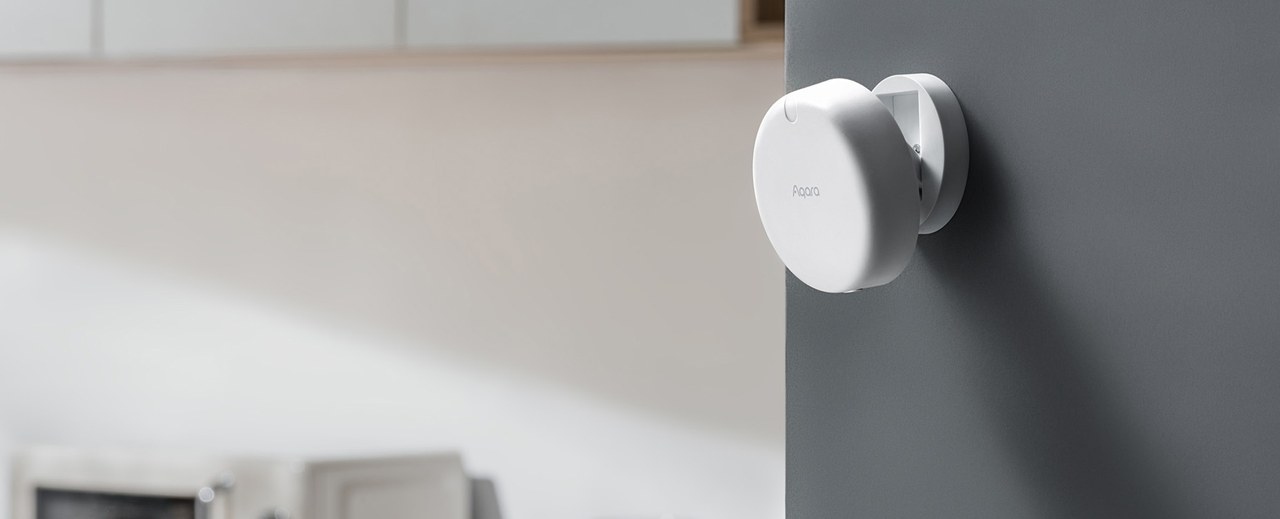
Lights that switch off while you sit at a desk expose a weakness of traditional motion detection: noticing someone arrive is not the same as knowing they are still there. Passive Infrared (PIR) sensors handle the first task well, while millimeter wave (mmWave) sensors can detect continued presence.
How PIR motion detection works
A PIR sensor passively watches for changes in infrared radiation rather than transmitting a signal. When a person moves into view, their body heat changes the background heat pattern, triggering the sensor. This makes PIR effective for detecting entry, exit, walking, and waving, but not tiny movements such as breathing.
Inside, a pyroelectric sensor responds to sudden heat changes rather than steady temperatures. The familiar domed cover is a Fresnel lens: its segments collect heat across a wide area and focus it onto the internal sensor, dividing the room into detection zones. Moving between zones shifts body heat across the sensing elements and produces a motion event.
When someone stays still within one zone, that changing signal disappears. The sensor may eventually report an empty room even though the person remains seated.
How mmWave presence detection works
An mmWave sensor actively transmits high-frequency radio waves and analyzes their reflections. Reflection timing, or “echo time,” helps it detect small movements precisely. Unlike PIR, it can register the chest movement of breathing or the small motions of typing, allowing it to recognize occupancy when someone is otherwise still.
These miniature radar systems also use the Doppler effect. A continuous high-frequency signal reflects from objects in view; a stationary object returns the same frequency, while movement produces a slight frequency shift. The sensor can detect the tiny shifts associated with human micro-motions.
Radio waves can pass through some light materials, including curtains, drywall, and wood, so an unobstructed view is not always necessary. However, penetration, range, and sensitivity depend on the frequency used.
Frequency bands and their tradeoffs
- 5.8 GHz: Prioritizes reach and penetration through furniture and other obstacles, making it useful in large or complex spaces. It sacrifices detail and may struggle with the small movements required for true presence detection.
- 24 GHz: Balances room-scale coverage with substantially greater precision than 5.8 GHz, including reliable breathing detection within its field of view. Its signals do not penetrate solid walls. Some models, including the Apollo Automation MTR-1, offer detection zones and multi-person tracking.
- 60 GHz: Provides exceptional sensitivity for subtle movements and tracking several people in a small area. Its shorter range and susceptibility to obstruction limit coverage, but suit precise monitoring of a bed for sleep tracking or an office desk.
Practical differences between PIR and mmWave
| Consideration | PIR motion sensors | mmWave presence sensors |
|---|---|---|
| Detection method | Passively detects changes in body heat. | Actively sends radar signals and analyzes reflections to map objects and movement. |
| Initial response | Responds almost instantly when someone crosses its view. | Also detects entry quickly, but signal analysis and false-trigger filtering can introduce a slight delay. |
| Stationary occupants | Cannot reliably detect fine movement or continued stillness. | Detects micro-movements such as breathing, supporting continued occupancy detection. |
| Obstructions | Needs direct line of sight; furniture and glass block its view. | Can detect through certain light materials, with capabilities varying by frequency. |
| False triggers | Rapid heat changes from direct sunlight or heating vents can cause triggers. | Unaffected by heat, but moving fans or rustling curtains can trigger it without suitable configuration. |
| Power | Very low consumption supports long-lasting battery operation. | Active radar consumes more energy and usually requires continuous wired power. |
| Cost and setup | Affordable, with few settings and little setup. | More expensive, typically with sensitivity or range adjustments that require initial configuration. |
Hybrid sensors combine both approaches
Some devices incorporate PIR and mmWave in one unit, using PIR for a fast initial response and radar to maintain presence detection.
When someone enters, PIR can turn on the lights and wake the more power-hungry mmWave sensor. Radar then monitors continued occupancy. After it confirms that the room is empty, it returns to a low-power sleep state while PIR remains active. This handover reduces the energy needed for presence detection.
Which sensor fits each room?
PIR for movement and transition areas
Hallways, staircases, garages, walk-in closets, and entryways generally need a quick response to someone passing through. PIR offers a reliable, inexpensive way to trigger those actions without needing to track a seated occupant.
Its low power demand also allows batteries to last for years, giving you flexible placement without a nearby outlet.
mmWave for rooms where people stay still
Living rooms, home offices, bathrooms, and bedrooms benefit from presence detection that continues while someone reads, works at a computer, or watches television. Detecting subtle movement helps keep lights and other automations active until the room is actually empty.
Plan placement around power access: mmWave processing requires more energy, and these sensors generally need a constant wired supply, such as a USB connection.
Combining sensors with Homey
Homey brings PIR and mmWave devices into one ecosystem, supporting sensors from brands including Aqara, Apollo Automation, Eve, Frient, IKEA, Thirdreality, Sonoff, and Meross.
Through Flows, a battery-powered PIR sensor can switch on the lights immediately, while an mmWave sensor keeps them on as you watch TV. Using each technology where it fits best combines fast, low-power motion detection with sustained occupancy sensing rather than treating either as a universal replacement.

