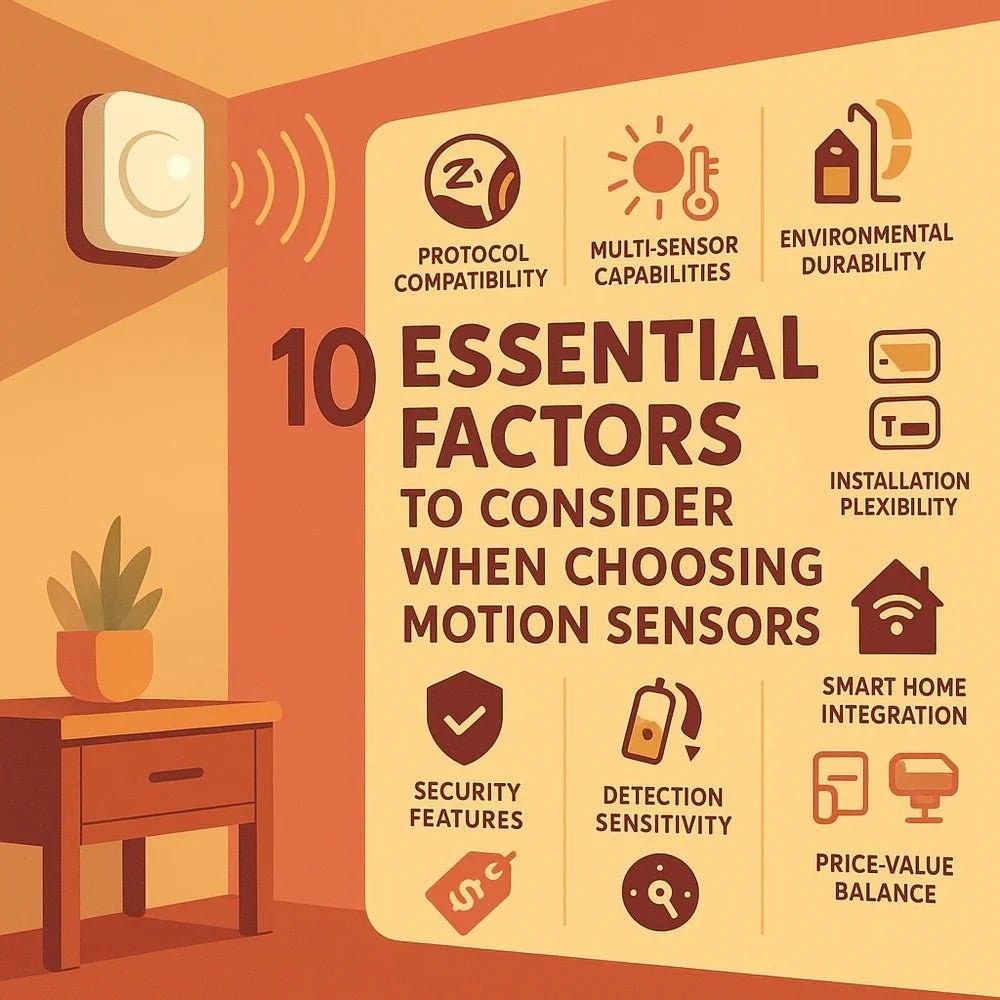
Motion sensors support smart home security, convenience, and energy savings by triggering responses to movement. The right choice depends on your rooms, automation goals, and existing system—not just the sensor's headline features.
Wireless protocol compatibility
A sensor's protocol determines which hubs it can communicate with. Z-Wave and Zigbee are the main options, with different strengths.
Z-Wave uses a dedicated frequency band (868.42 MHz in Europe), offering strong resistance to interference from Wi-Fi and other household devices. Its mesh network becomes stronger as devices are added, with each sensor acting as a repeater to increase range and reliability.
Zigbee also supports mesh networking, with faster responses and lower power consumption that suit battery-powered sensors. Zigbee 3.0 adds interoperability and security features for long-term compatibility.
Choose a protocol supported by your current hub, or one that fits the ecosystem you intend to build.
Detection range and coverage
Typical detection ranges span 4 to 12 meters, with coverage angles of 110 to 170 degrees. Wider coverage can reduce the number of devices needed, lowering cost and installation complexity.
Match coverage to the layout: open-plan spaces benefit from longer range and wider angles, while corridors and smaller rooms may suit narrower detection patterns. Ceiling-mounted models can offer 360-degree coverage; wall-mounted units provide directional monitoring aimed at an area or entrance. Plan placement to avoid blind spots and unnecessary overlap.
Additional sensing functions
Multi-sensors can contribute more than motion events to your automations:
- Temperature readings allow heating and cooling to respond to occupancy and ambient conditions.
- Light sensing can prevent lights from switching on when daylight is sufficient.
- Tamper detection warns of attempts to interfere with or disable a device, supporting more comprehensive security monitoring.
Check that your ecosystem supports these extra functions and that they serve your climate, lighting, or security goals.
Battery life and maintenance
Standard sensors commonly run for 1-2 years, while premium models with advanced power management can last up to 5 years. Standard AAA batteries are convenient to replace and are often supplied with the sensor. CR2 batteries offer longer life but can cost more and be harder to find.
Configurable reporting intervals let you trade responsiveness against battery consumption. Low-battery notifications provide warning before a device stops working. Longer battery life is especially useful in hard-to-reach locations; accessible sensors can more conveniently use frequent reporting for faster responses.
Environmental suitability
Most indoor models operate reliably from -10°C to 45°C. Unheated rooms, garages, and locations with large temperature swings may need a wider operating range.
For bathrooms, kitchens, and other damp areas, consider humidity resistance. Models tolerating up to 95% humidity can operate without degradation or false triggering in these conditions. Outdoor or moisture-exposed installations need suitable IP protection against water ingress; outdoor-specific models may also include weatherproof housings and stronger environmental protection.
Mounting and appearance
Wall mounting gives precise directional control and convenient battery access, making it useful for entrances and defined areas. Ceiling mounting covers broader spaces and, on some models, provides 360-degree detection. Ball-design sensors suit discreet ceiling installation and can use supplied lens covers to adjust detection patterns.
Magnetic mounts make repositioning easier without permanent mounting hardware, particularly while refining placement. Models offering both wall and ceiling installation provide more flexibility. Balance appearance with effective coverage.
Platform integration
Support for separate motion detected, motion cleared, and tamper alerts enables more detailed automation than basic on/off detection. Although most Zigbee and Z-Wave sensors work with SmartThings, Hubitat, and Home Assistant, available functions can differ by platform: a sensor may offer all its features on one hub but only motion detection on another.
Custom drivers, continuing updates, and platform-specific optimization can improve functionality and long-term value. Check support for the scenes, security systems, and energy-management routines you plan to use.
Security protections
For security use, prioritize tamper protection and encrypted communications. Tamper alerts report attempts to disable a sensor, while encryption protects wireless motion data against interception or manipulation.
Some models also offer anti-masking detection, warning when someone blocks their view. These protections make sensors more suitable for comprehensive, professional-grade monitoring.
Sensitivity and detection customization
Adjustable sensitivity helps avoid triggers from pets or environmental conditions while retaining reliable human-motion detection. Lens covers and detection masks can exclude unwanted areas, including busy streets visible through windows or places pets frequently occupy.
Configurable patterns or zones provide further control in difficult layouts. Assess likely false-trigger sources before choosing a model: fine adjustment can be crucial to dependable automation.
Price and long-term value
- Basic models (£25-35): Reliable motion detection, standard battery life, and basic integration.
- Mid-range models (£35-45): Often add temperature sensing, longer battery life, and improved integration, offering strong value for most smart homes.
- Premium models (£45-65): Offer the longest battery life, advanced features, and comprehensive platform support, often with professional-grade security, extensive customization, and extended warranties.
Compare total ownership cost, including replacement batteries, any required hub, and continuing manufacturer support. A higher purchase price can be offset by less maintenance and longer-term support.
Recommended sensors by use case
- Budget choice: The Vesternet Zigbee Motion Sensor costs £25 and combines 110-degree detection with tamper protection, broad platform support, custom drivers, and extensive documentation.
- Multiple sensing functions: The Zigbee Frient Motion Sensor Pro combines motion, light, and temperature sensing with 3-year battery life for broad automation and healthcare monitoring applications.
- Premium features: The Aeotec SmartThings Motion Sensor offers a compact design, motion and temperature sensing, seamless SmartThings integration, and reliable Zigbee connectivity for sophisticated routines.
- Outdoor use: The Z-Wave Philio Motion Sensor PSP05 - Gen5 offers IP43 waterproof protection, 12-meter detection range, customizable detection areas, and robust outdoor performance to extend security beyond the home.
- Advanced adjustment: The Aqara Motion Sensor P1 provides a 170° field of view, an adjustable viewing angle with a 360° stand, a configurable detection timeout from 1-200 seconds, and 5-year battery life.
- Basic automation: The Zigbee Frient Motion Sensor Basic costs £30 and offers reliable motion detection with 3-year battery life for straightforward lighting and music automation without additional sensing features.

