Door sensors monitor entry points and trigger smart home automations. To choose models that suit your home, weigh compatibility, installation needs, security features, and ongoing maintenance—not just basic detection.
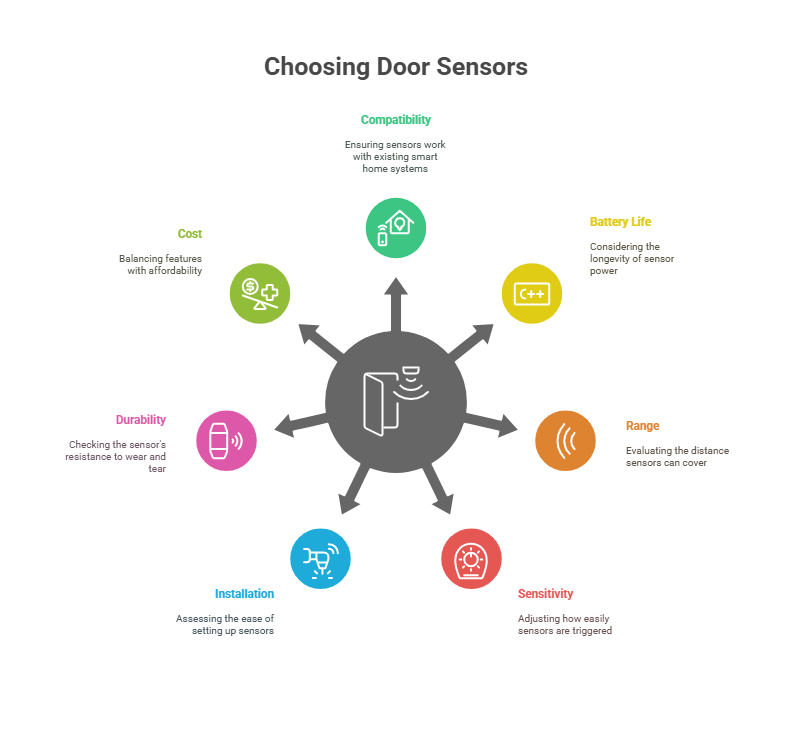
Wireless protocol compatibility
A sensor’s wireless protocol determines which systems it can communicate with. Z-Wave and Zigbee both provide reliable, low-power mesh networking.
Z-Wave uses a dedicated frequency band—868.42 MHz in Europe—to limit interference from Wi-Fi and other household devices. It offers strong range and reliability, with each device acting as a repeater to reinforce the network.
Zigbee offers similar mesh capabilities with faster responses and lower power consumption, making it well suited to battery-powered sensors and homes with many smart devices. Choose sensors that match your existing hub or the hub you intend to buy.
Size and appearance
Traditional two-piece sensors use a sensor and magnet mounted on the frame and door. Separating the pieces triggers an alert. This design is versatile but relatively visible.
Ultra-thin models are less conspicuous, while some strip sensors can be concealed entirely within the frame. Balance the available mounting space and your preferred appearance with the functions you need.
Battery life and maintenance
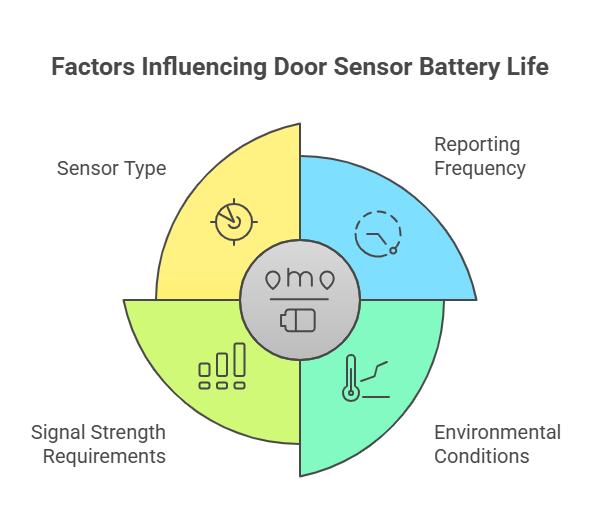
Most door sensors run on batteries. Standard models typically last 1-2 years under regular use, while premium versions can reach 5-10 years through more advanced power management.
Actual consumption depends on reporting frequency, environmental conditions, and signal requirements. More frequent transmissions or longer transmission distances use more power. Low-battery notifications help you replace batteries before monitoring stops.
Additional sensing functions
Some models combine open/close monitoring with other capabilities:
- Temperature sensing: Tracks conditions across rooms to support more efficient heating and cooling.
- Vibration or tilt detection: Can flag attempts to force a door or window before it fully opens.
- Light sensing: Can detect a door opening in darkness, potentially indicating unauthorized access.
Range and network coverage
Z-Wave Plus and Zigbee sensors typically reach 30-100 meters in open spaces, but walls and other obstructions can substantially shorten that distance.
Consider your floor plan and hub position. Larger homes or heavily obstructed installations may need stronger transmission capabilities or enough repeater devices to extend coverage.
Smart home integration
Check compatibility with platforms you use, such as SmartThings, Home Assistant, or Apple HomeKit. Flexible integration lets sensors do more than send alerts.
For example, a door opening could switch on lights, an open window could trigger a thermostat adjustment, or unusual access times could generate notifications. Choose sensors that support the automations you want within your existing setup.
Security protections
For security-critical monitoring, consider tamper detection and encrypted communications. Tamper alerts warn when someone tries to remove or disable a sensor, while encryption protects signals between the sensor and hub against interception.
Environmental suitability
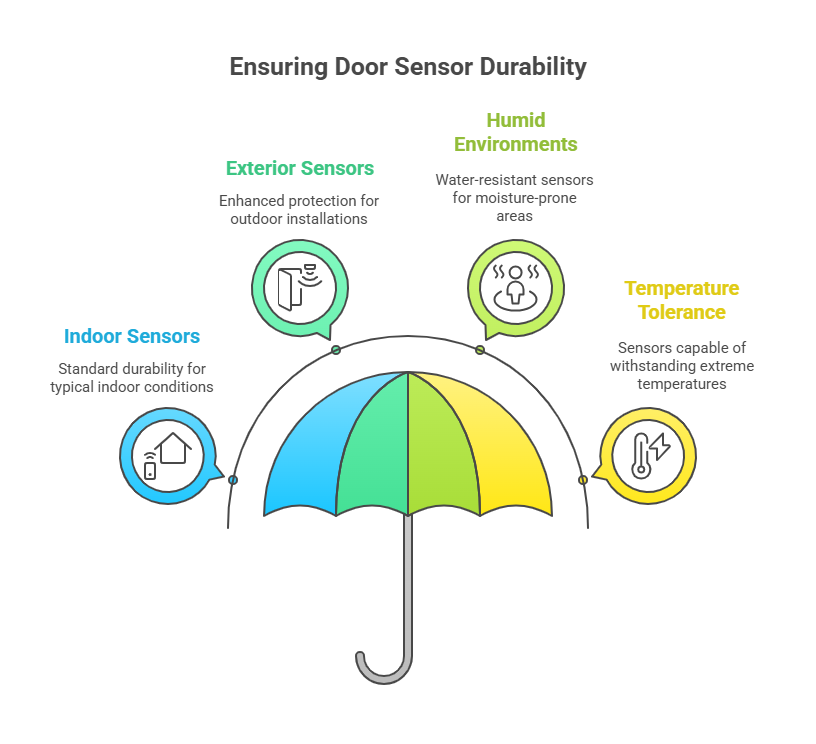
Ordinary indoor locations generally need standard durability. Exterior doors, bathrooms, and other humid areas require greater protection; outdoor or moisture-exposed installations need water-resistant or waterproof sensors.
Also check temperature tolerance for unheated spaces or outdoor locations with extreme temperatures. Match the environmental ratings to the mounting location for dependable long-term use.
Setup and controller requirements
Installation varies between models. Some offer “auto-include” for straightforward, tool-free setup, while others require more involved configuration.
Confirm whether a sensor needs a particular hub or works with standard Z-Wave or Zigbee controllers. Clear instructions and a simple inclusion process are especially valuable when installing several sensors.
Price and total ownership cost
- Basic models (£20-30): Reliable open/close monitoring with standard battery life.
- Mid-range models (£30-45): Often add sensing functions and better battery performance.
- Premium models (£45-65): May offer the longest battery life, smaller designs, tamper protection, or environmental monitoring.
Include replacement batteries and any necessary hub or controller when comparing overall value.
Models for different priorities
The source recommends the following options for specific requirements:
- Discreet installation — Vesternet Zigbee Door Sensor: An ultra-slim design that blends into door frames, with reliable operation and excellent battery life.
- Maximum battery life — Z-Wave Plus Sensative Strips Guard 800: Up to 10 years of battery life makes it suitable for difficult-to-reach positions.
- Advanced features — Z-Wave Fibaro Universal Door & Window Sensor 2: Combines open/close monitoring, temperature sensing, and tamper protection in a sleek, customizable design.
- Multiple sensing functions — Zigbee Aeotec SmartThings Multipurpose Sensor: A compact option combining door/window monitoring with vibration and temperature sensing.
- Professional-grade monitoring — Z-Wave Plus Aeotec Door/Window Sensor 7 Pro: Offers enhanced reliability, a replaceable circuit board, and connections for additional binary sensors.
- Budget-conscious selection — Aqara Door and Window Sensor T1: Provides solid performance at an attractive price with good smart home platform compatibility.
- Specialized installations — Nice Door/Window Control: Combines compact dimensions with versatile functions for a range of installation scenarios.
Match these tradeoffs to your entry points, smart home platform, and maintenance preferences to find sensors that support both security and useful everyday automation.

