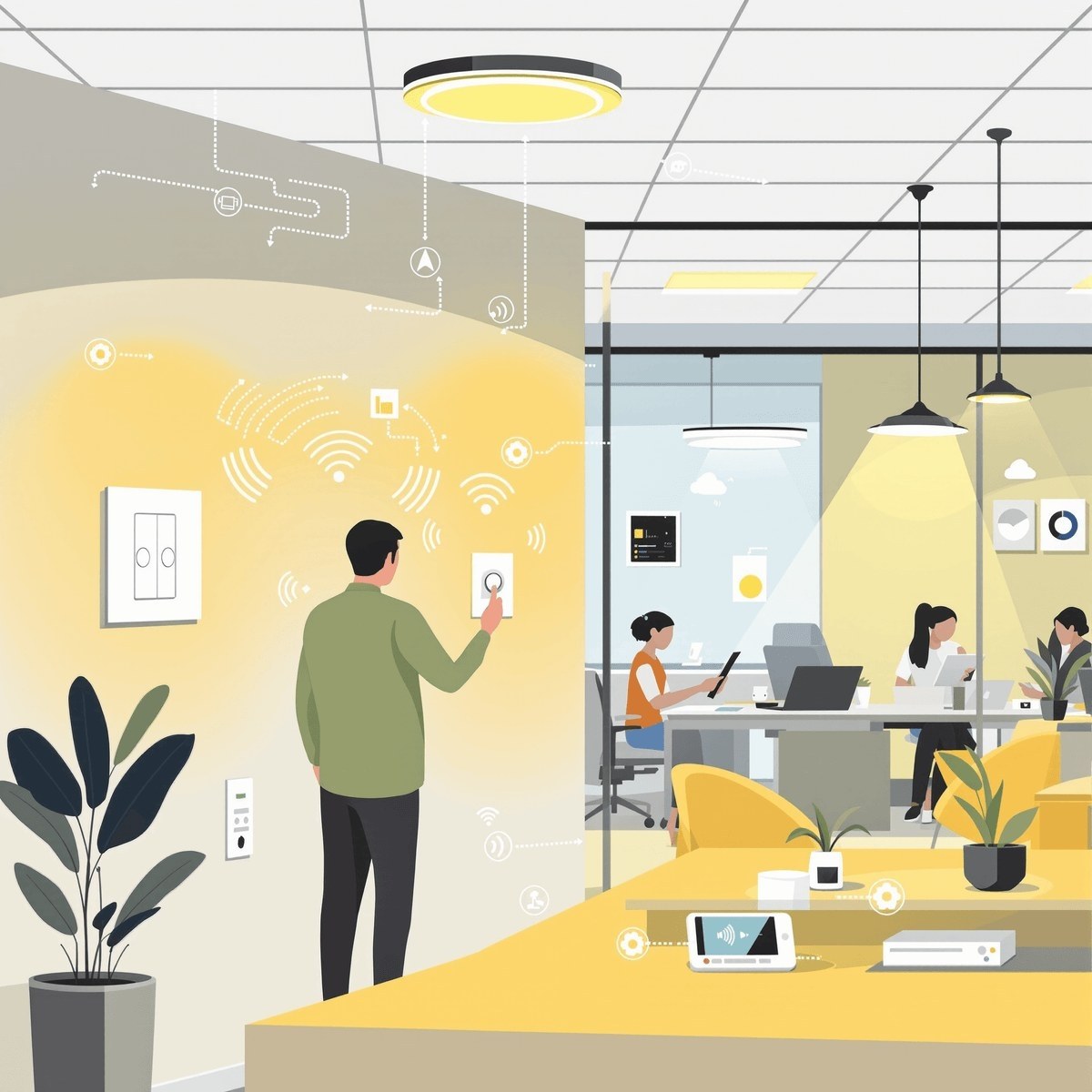
Commercial lighting needs more than on/off control. Professional dimming systems can respond to occupancy, daylight and operating schedules while supporting changing requirements. Wireless connectivity, programmable scenes and power monitoring allow facility managers to coordinate lighting through building management systems, analyse consumption and improve occupant comfort.
For retrofits and new installations alike, the following ten considerations help match controllers to the building’s infrastructure, lighting loads and long-term expansion plans.
Wireless protocols and system compatibility
The wireless protocol determines communication range, reliability and integration options. Check compatibility with existing automation controllers as well as planned additions.
- Z-Wave supports mesh networking with distances up to 100 metres between devices, making it useful in challenging RF environments.
- Zigbee accommodates dense device networks and extensive dimmer arrays across multiple commercial zones.
- Thread offers future-ready connectivity with Matter compatibility for universal device integration.
- Wi-Fi provides direct cloud connectivity but depends on robust network infrastructure.
Dimming technology and lighting loads
Match the dimming method to the fixtures to maintain smooth, flicker-free output throughout the brightness range.
- Leading Edge dimming suits resistive loads, including incandescent and halogen fixtures.
- Trailing Edge dimming performs better with LED drivers and electronic transformers.
- 0-10V dimming provides precise control of commercial LED fixtures and fluorescent ballasts.
- DALI compatibility supports advanced lighting management in professional installations.
Automatic load detection simplifies installation and helps prevent LED flicker, premature lamp failure and audible noise across different fixture types.
Wiring and mounting flexibility
Wiring requirements affect installation complexity and cost. Two-wire systems simplify retrofits without neutral conductors; three-wire configurations offer greater stability and support higher wattage loads. Controllers supporting both reduce specification constraints.
- Behind-switch mounting preserves aesthetic flexibility and simplifies wiring changes.
- DIN rail mounting suits centralised control panels in professional buildings.
- Gang box compatibility allows integration with standard electrical infrastructure.
- Modular designs support expansion without extensive rewiring.
Power monitoring and energy analysis
Integrated monitoring turns a dimmer into an energy-management tool, helping commercial sites control operating costs and pursue sustainability targets.
- Real-time consumption tracking highlights anomalies and inefficiencies.
- Historical usage data informs schedules and dimming strategies.
- Peak demand monitoring helps avoid commercial utility penalties.
- Load verification checks installation quality and flags maintenance needs.
Advanced controllers can relate consumption to occupancy and daylight, adjusting brightness to maintain appropriate illumination with less wasted energy and manual intervention.
Control interfaces
Interfaces should accommodate different users while remaining consistent across zones. Options range from conventional switches to touch panels: glass surfaces suit contemporary interiors, while rotary controls provide tactile feedback for precise adjustment.
- Touch-sensitive controls avoid mechanical wear and offer configurable feedback.
- Rotary encoders provide precise brightness adjustment with tactile response.
- Momentary switches support single-tap, double-tap and hold functions.
- LED indicators make status visible in low light.
Dimming range and transition quality
From accent lighting to task illumination, professional controllers need consistent output without visible steps or flicker.
- A full 1-100% dimming range accommodates varied lighting needs.
- Configurable minimum brightness maintains gentle illumination rather than complete darkness.
- Adjustable ramp rates create smoother, more comfortable transitions.
- Percentage-based control makes scene settings repeatable.
Advanced dimmers use gamma correction and colour temperature compensation to maintain consistent perceived brightness throughout the range, supporting the demands of commercial and hospitality spaces.
Multi-channel and zone control
Multi-zone installations need coordinated scenes without losing independent adjustment. Dual-channel dimmers control separate circuits, allowing hospitality and commercial spaces to change lighting moods throughout their operating cycles.
- Independent brightness settings suit areas with different functions.
- Synchronised dimming creates smooth transitions between adjoining spaces.
- Zone grouping simplifies operation while preserving individual adjustment.
- Phase balancing supports appropriate electrical distribution in three-phase installations.
Security and access protection
Encryption and authentication help protect lighting networks from unauthorised access, particularly in mission-critical environments.
- S2 security encryption provides military-grade protection for wireless communications.
- SmartStart inclusion supports secure device provisioning without compromising network access.
- Authenticated command processing blocks unauthorised control attempts.
- Tamper detection alerts administrators to possible interference or security breaches.
Network segmentation separates lighting controls from other building systems to reduce the attack surface while retaining operational flexibility. Regular security updates maintain protection against emerging threats throughout the installation’s life.
Automation and scene programming
Sensor and building-management integration lets lighting respond to occupancy, schedules and environmental conditions. Preset scenes and automatic scheduling reduce manual adjustments while keeping illumination consistent with operational needs.
- Occupancy-based dimming saves energy while maintaining comfort.
- Daylight harvesting adjusts artificial lighting to supplement available natural light.
- Time-based schedules follow building usage and operating hours.
- Sensor integration adapts lighting to changing environmental conditions.
Reliability and safety
Commercial controllers need protection mechanisms that support continuous operation and prevent damage under demanding conditions.
- Overheating protection reduces the load or shuts the device down to prevent thermal damage.
- Overpower safeguards protect against excessive loads that could shorten device life.
- Overvoltage protection shields electronics from surges and spikes.
- Power-off memory restores earlier settings after an interruption.
- Self-diagnostics identify potential problems before performance suffers.
Professional-grade units combine robust construction, extended temperature ranges and enhanced EMC compliance. Rigorous testing checks safety, performance and electromagnetic compatibility against industry standards.
Controllers for different installation needs
Budget-conscious offices and warehouses
The Z-Wave Zooz 0-10 V Dimmer combines advanced 0-10V LED driver compatibility, Z-Wave Long Range technology and configurable brightness. Power monitoring and scene programming make it an option for reliable automated lighting without sacrificing essential professional features.
Mid-range homes and smaller commercial spaces
The Zigbee Aqara Dimmer Switch H2 offers a multifunction dial, 1-100% dimming precision and dual protocol support (Thread/Zigbee). Energy monitoring and power-off memory complement its design for smart homes and small commercial installations.
High-end hospitality and corporate interiors
The Z-Wave Plus MCO Home Glass Touch Dimmer pairs a glass touch interface with automatic light source detection. Support for two-wire and three-wire systems gives premium installations flexibility alongside professional functionality and reliability.
Large-scale centralised installations
The Shelly Wave Pro Dimmer 2PM provides dual-phase control, power monitoring, DIN rail mounting and advanced safety protections. Its modular construction supports scalable, centralised lighting management in hotels, office buildings and industrial facilities.
Matching the controller to the project
Start with protocol requirements, wiring constraints and preferred interfaces, then check load compatibility, safety protections and automation features against the building’s standards and expansion plans. The right combination supports energy efficiency, occupant comfort and dependable operation.
Vesternet offers professional dimming solutions and wall controller dimmers, with technical documentation, design and implementation advice, and ongoing support.

