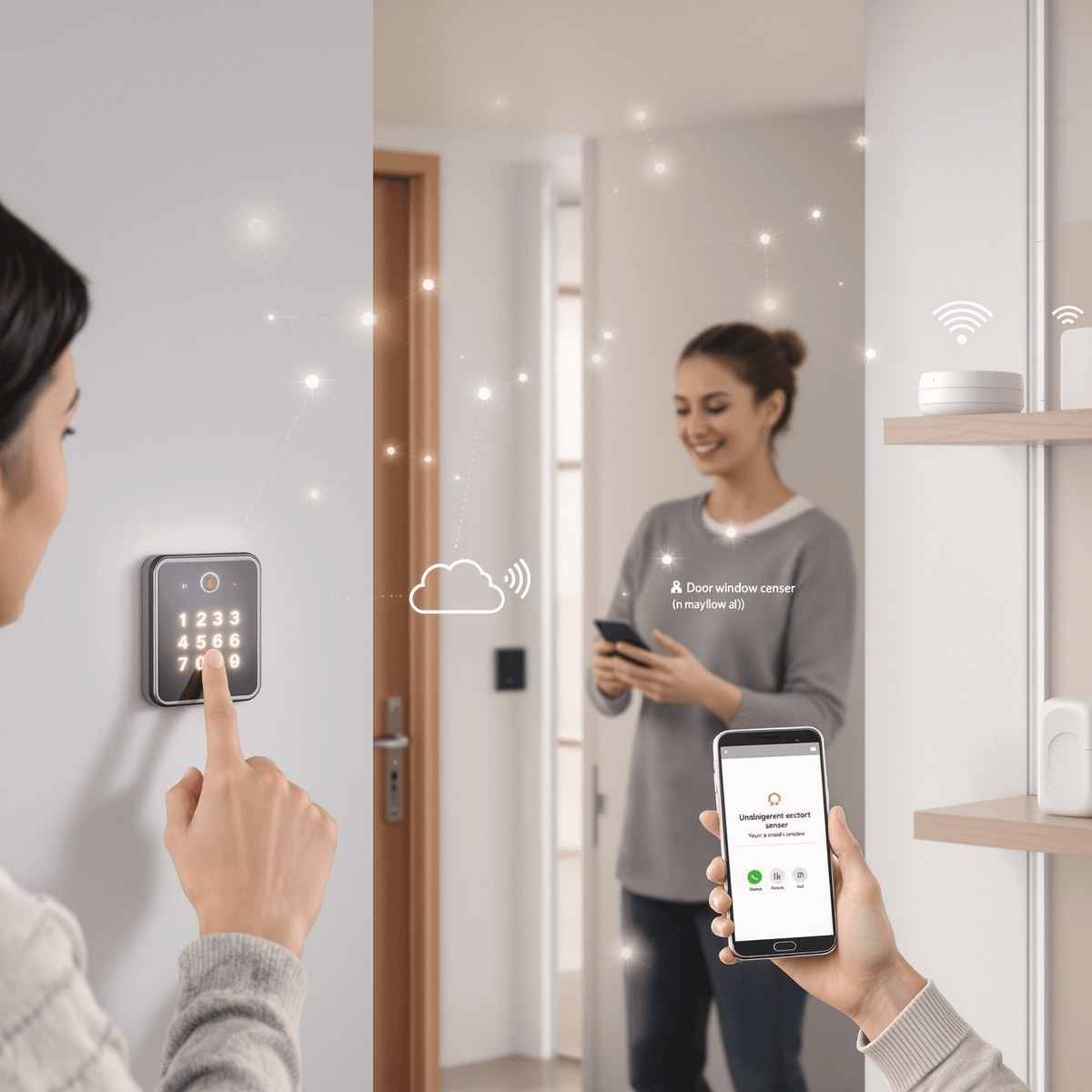
Opportunistic break-ins are a growing concern for UK households, yet basic alarms, deadlocks and standalone CCTV can leave gaps when they operate independently. Entry points may go unmonitored, notifications may arrive too late, and recordings may only become useful after an incident. Passive recording is not the same as an active response.
As UK smart home adoption grows, homeowners increasingly expect cameras, door and window sensors, motion detectors, keypads and sirens to work together. Connected through protocols such as Z-Wave, Zigbee and Matter, these devices can provide immediate alerts, remote arming and disarming, and coordinated visual and audible deterrents. The following 11 areas cover the components and planning decisions needed to build or upgrade that layered system.
Intelligent security cameras
A connected security camera should do more than save footage. Suitable models can interpret activity, initiate responses and, in some cases, manage other smart devices. Compare these capabilities:
- AI detection that differentiates people, animals and vehicles.
- Full-colour night vision for identifying subjects in low light.
- Dual-band Wi-Fi for dependable connectivity with less interference.
- Local recording alongside cloud storage for resilience and privacy.
Cameras with built-in Zigbee, Matter or Thread support can also serve as smart home hubs, reducing the number of separate controllers required. For outdoor use, check the IP rating and operating temperature range. Assess end-to-end encryption as well, since both recordings and network security need protection.
Compatible wireless protocols
Before choosing devices, establish which protocols your hub supports. Buying components without checking compatibility is a common and potentially expensive mistake.
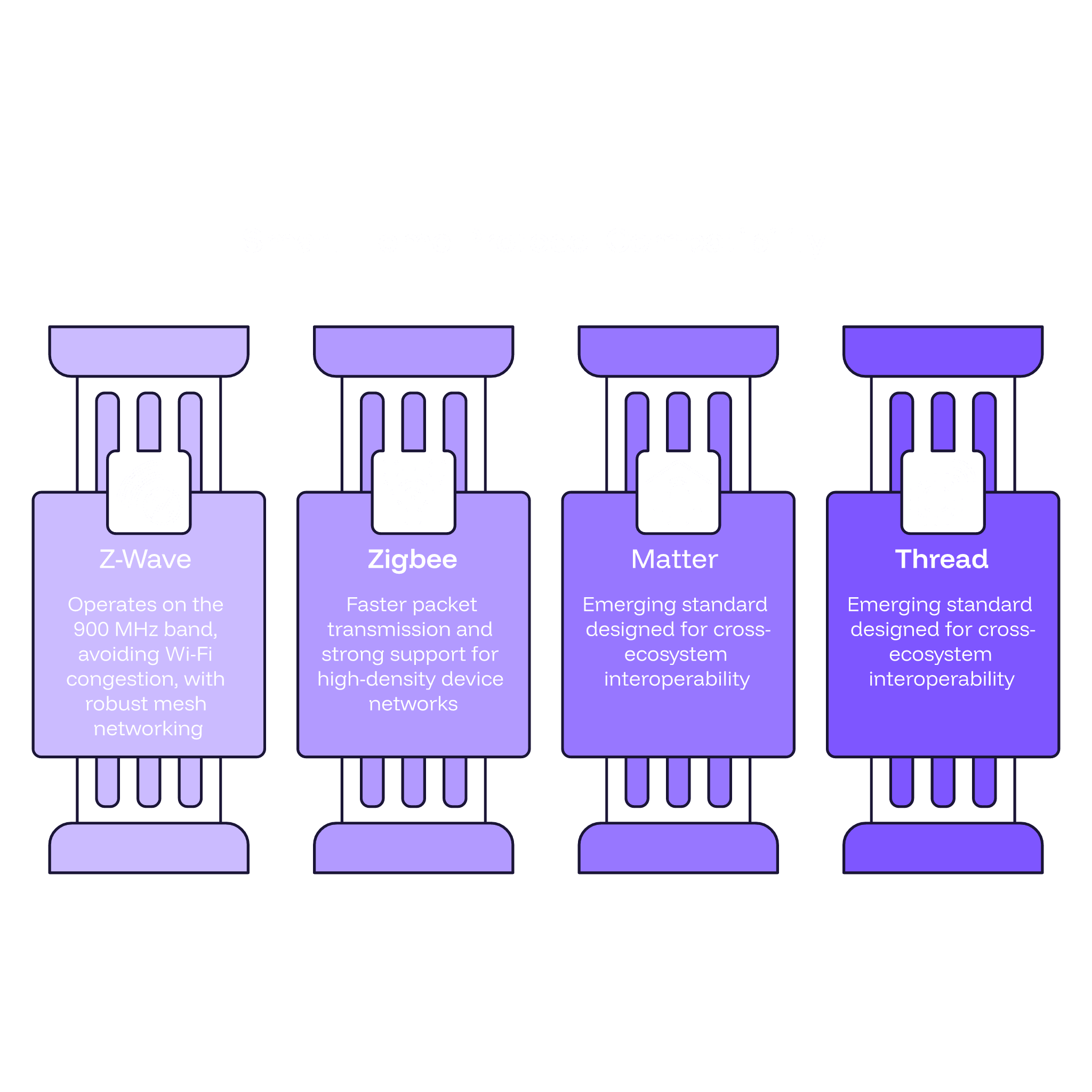
- Z-Wave: uses the 900 MHz band to avoid Wi-Fi congestion and supports robust mesh networking.
- Zigbee: offers faster packet transmission and supports dense device networks.
- Matter and Thread: emerging standards intended to improve interoperability across ecosystems.
A mixed-protocol installation is possible, but bridging needs careful planning. Some camera hubs control Zigbee, Matter and Thread devices simultaneously, reducing the need for additional bridges. Match every proposed purchase to the capabilities of your chosen hub.
Door and window monitoring
Doors and windows are the most common entry points for intruders in UK homes, making perimeter sensing a priority. Detection accuracy and wireless coverage vary considerably, so look beyond basic open/close reporting.
- Open, closed and tilt detection for more complete monitoring.
- Z-Wave Long Range support for larger or multi-floor properties.
- Adhesive mounting for rented homes or screw fixing for permanent installations.
- Suitable battery life, with temperature or humidity sensing where useful.
Tilt detection can identify a window left slightly ajar that a basic open/close sensor would miss. In homes with thick walls, several floors or a large footprint, Z-Wave Long Range extends dependable coverage beyond standard protocols, helping avoid sensors operating at the limit of their range.
Outdoor motion detection
Outdoor sensors bring driveways, gardens, paths and outbuildings into the security perimeter. They can initiate a response before someone reaches the house, but reliable outdoor operation requires more than an indoor sensor can offer.
- Adjustable PIR sensitivity to limit false alarms from wildlife and moving foliage.
- Lux monitoring for contextual actions, such as switching lights on only after dark.
- Weather resistance and an appropriate operating temperature range.
- Battery power for flexible positioning or low-voltage wiring for continuous operation.
Also check whether motion-clear times are configurable. This setting determines how long after movement stops the sensor returns to its ready state. Appropriate adjustment helps prevent repeated notifications while retaining useful alerts.
Keypads and controlled access
Physical keys can be lost, copied or passed to others without permission. Smart keypads instead use programmable PIN codes and RFID tags to control who can enter and when. This is particularly useful for landlords, visiting contractors, guests and households with several residents.
Look for temporary access codes and an entry-event audit trail. Tamper detection should generate an immediate alert if the keypad is disturbed or forcibly removed. Many models also provide a convenient way to arm or disarm the wider alarm system at the door.
- Proximity-activated backlighting for visibility at night.
- Both PIN and RFID tag access.
- Indoor and outdoor installation options, using adhesive or screws.
- Tri-colour indicators that clearly show system status.
Audible and visual deterrents
A loud, unexpected siren can prompt an intruder to leave and attract neighbours' attention. Sound output matters, but a useful siren should also provide:
- An appropriate maximum dB output and adjustable volume.
- Different selectable tones for different events.
- A visual strobe to accompany the audible warning.
- Battery backup that maintains operation during a power cut.
Some sirens also act as notification speakers for smoke, carbon monoxide and leak detectors, extending their role beyond burglary protection. Plug-in models simplify installation compared with hardwired units, while optional wall or ceiling mounting keeps them out of easy reach.
Encryption and tamper protection
A compromised smart device could potentially undermine the security system it belongs to. Unsecured connected devices have been exploited in real incidents, so wireless protection is a baseline requirement rather than an optional feature.
S2 is the gold standard for Z-Wave security in this context. It combines AES-128 encryption with multi-layer authentication to protect against eavesdropping, replay attacks and device spoofing. Hardware tamper detection adds protection by reporting physical interference with sensors, keypads or sirens.
- Require S2 security with AES-128 across Z-Wave security devices.
- Look for SmartStart QR-code provisioning for secure, straightforward pairing.
- Check for hardware tamper detection on sensors and keypads.
A layered system design
Good individual components are only part of the solution. Arrange different device types so that they cover complementary areas and situations:
- Perimeter detection: outdoor motion detectors and door and window sensors monitor the outer boundary.
- Access control: keypads and connected locks manage authorised entry.
- Interior monitoring: cameras and indoor motion sensors provide detection and visual verification.
Automation connects these layers. For example, a door opening could start a keypad countdown. If nobody enters a valid code within the allowed interval, the system could activate the siren and start motion-activated camera recording. This turns separate devices into a coordinated response system.

Remote alerts and local processing
Security information is only useful if it arrives promptly and allows a response. Before selecting a platform, examine remote arming and disarming alongside these features:
- Fast, consistent push notifications under different network conditions.
- Live-stream quality and latency when viewing remotely.
- Two-way audio for immediate communication or verbal deterrence.
- Customisable notifications that reduce low-priority alert fatigue.
Prioritise hub-based local processing over complete dependence on the cloud. Cloud-only systems lose functionality when the internet connection fails. Local processing reduces latency and allows automated responses to continue during a broadband outage.
Installation and power choices
Choose each device's power source according to its location and purpose. Battery models require no wiring and offer flexible placement. Mains-powered devices provide continuous operation, with backup batteries acting as a failsafe. Neither approach is best for every installation.
Wireless coverage and future expansion
Plan coverage carefully in large or multi-storey homes. Z-Wave mesh networking allows devices to relay signals, so adding sensors and increasing device density can improve overall range and reliability. An incremental installation can therefore offer technical as well as budget benefits.
- Check that the hub can accept future devices without a full reconfiguration.
- Allow protocol flexibility for Z-Wave and Zigbee additions.
- Consider how mesh resilience will develop as the system expands.
Integration with the wider smart home
Compatibility with Apple HomeKit, Amazon Alexa, Google Home and Home Assistant differs between manufacturers and devices. Matter's cross-ecosystem approach is making integration more accessible, but the key question remains what each component can do with the rest of your system.
Standalone devices cannot deliver the coordinated responses available through deeper integration. Useful scenarios include:
- A motion event starts recording on connected security cameras.
- An outdoor motion sensor switches on exterior lights.
- A door or window sensor triggers exterior lighting and a keypad countdown.
- Forced-entry detection activates a siren.
- Emergency mode engages all connected locks, activates all sirens and sends alerts simultaneously.
- Presence detection automatically arms away mode when the last resident leaves.
The benefit lies not simply in each device's features, but in their ability to exchange information and trigger appropriate actions.

Security components available from Vesternet
The following options cover key security roles, with different strengths in sensing, integration, access management and deterrence.
Aqara Camera Hub G5 Pro
The Aqara Camera Hub G5 Pro combines surveillance and device control in one IP65-rated, weatherproof unit. Its features include full-colour night vision, AI detection, dual-band Wi-Fi with WPA3 encryption and a built-in 100 dB siren.
It also serves as a Zigbee hub, Matter controller and Thread router, allowing direct management of Zigbee sensors without a separate bridge. Onboard local storage, HomeKit Secure Video support, NAS compatibility and RTSP streaming provide several options for footage control and integration. It sits at the higher end of the investment range, with particular value for users building an ecosystem around one central device.
Aeotec Door Window Sensor 8
This Z-Wave 800 Series sensor monitors open, closed and tilt states. Its Z-Wave Long Range capability offers substantially extended indoor coverage compared with standard smart home protocols, making it particularly suitable for large homes or difficult layouts.
- Three-state detection for door and window monitoring.
- Z-Wave Long Range for dependable extended coverage.
- Additional temperature and humidity monitoring.
- S2 encryption and SmartStart QR pairing.
Zooz outdoor motion sensor
This weather-resistant Zooz sensor combines outdoor motion detection with ambient light monitoring. Movement can trigger cameras, lights, alarms or sprinkler systems, supporting both security and convenience automations.
Adjustable lux thresholds, sensitivity and motion-clear times let experienced users tune it to local conditions. Battery or low-voltage hardwired power, S2 security and SmartStart support make it a practical mid-range option for extending perimeter coverage without unnecessary complexity.
Frient Keypad
The Frient Keypad supports PIN codes and RFID tags for residential and light commercial access control. Traceable entry management suits multi-resident homes, frequent visitors and property managers who need contractor access logs without distributing keys. It can also arm and disarm a connected alarm system at the entrance.
- Tamper detection that immediately alerts the system to interference.
- Proximity-activated backlighting for night-time operation.
- Tri-colour LED status feedback.
- Screw or adhesive-tape mounting for indoor and outdoor installation.
Aeotec Siren 6
The Aeotec Siren 6 is an indoor Z-Wave siren with a 105 dB speaker, adjustable volume, 15 selectable tones and a high-output strobe LED array. It can also provide additional notifications from Z-Wave smoke, CO and leak detectors.
A continuously recharging built-in backup battery maintains operation during power cuts. Three layers of Z-Wave Plus S2 wireless security protect against signal interference. Its plug-in design and optional wall or ceiling mounting allow installation without specialist assistance, offering capable deterrence without professional installation costs.
Planning your installation
Start by auditing vulnerable areas, including the front and back doors, ground-floor windows and driveway. Then identify the protocol ecosystem that matches your existing or planned hub.
Build around a dependable central device, prioritising S2-encrypted Z-Wave or Zigbee components for the security layer. Choose a camera solution with local storage for outage resilience, and connect sensors, access controls and sirens through coordinated automation sequences.
You do not need to install everything at once. Beginning with perimeter sensors and a siren, then adding cameras and keypads, allows costs to be spread while developing a layered system. Vesternet offers cameras, door and window sensors and sirens, with personalised guidance available for choosing components that suit a particular setup.

