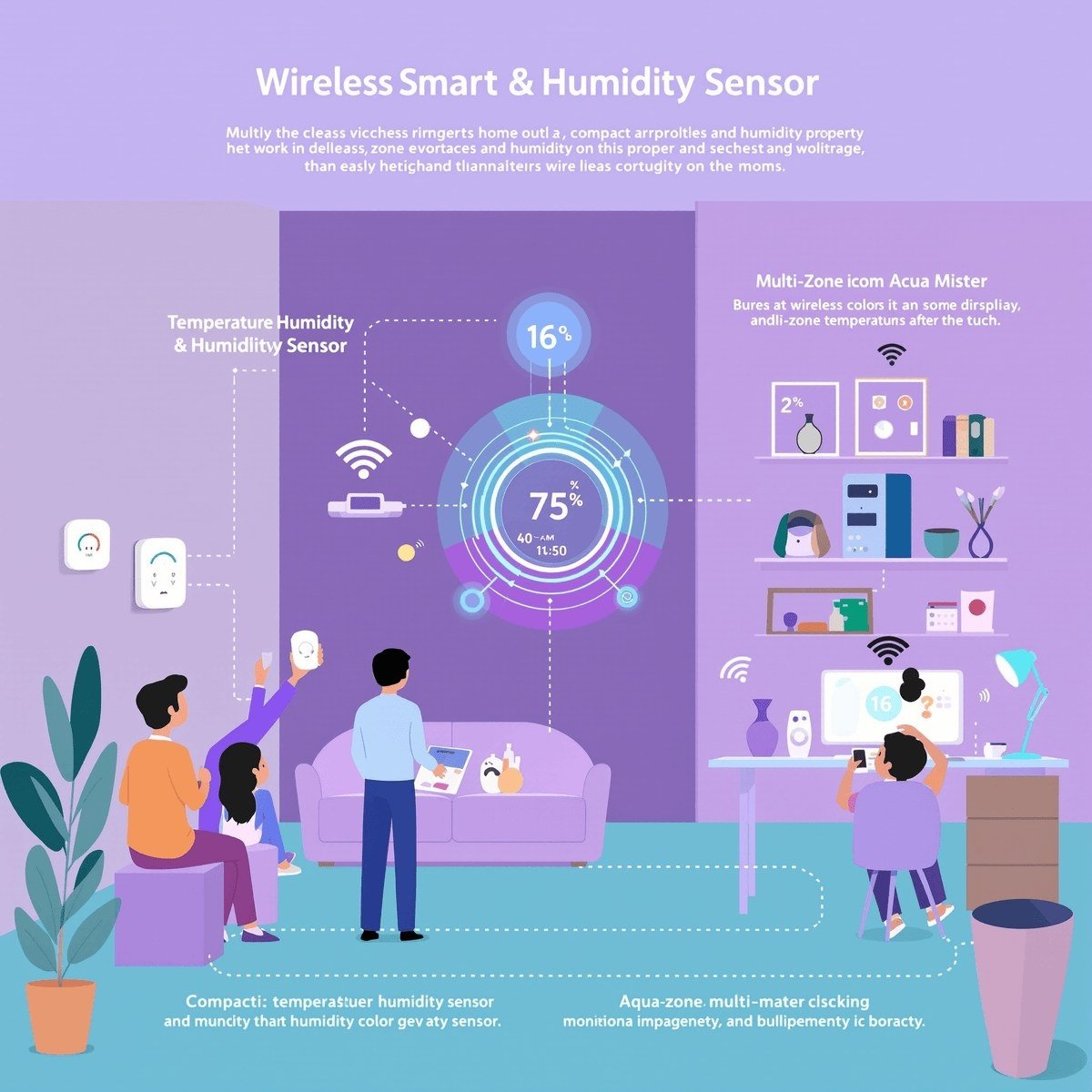
A hallway thermostat cannot reveal conditions throughout a property: a basement may be damp, a server room too hot, or a nursery subject to overnight changes. Without measurements from those spaces, humidity damage can go unnoticed and heating or cooling may run on unrepresentative data.
Battery-powered wireless temperature transmitters distribute sensing across rooms without extensive cabling. Devices using Z-Wave, Zigbee, Thread, and Matter can supply real-time readings for multi-zone monitoring and automated HVAC responses while keeping power consumption low. Choosing one requires more than comparing temperature specifications: compatibility, placement, reporting behaviour, maintenance, and security all matter.
Protocol compatibility
Start with the wireless technology your hub or controller supports. A capable sensor is of little use if it cannot communicate with the rest of the system.
- Z-Wave: Uses a dedicated sub-GHz frequency and mandatory interoperability certification to reduce interference and support reliable operation between manufacturers.
- Zigbee: Operates at 2.4 GHz, with a broad ecosystem and widely available hardware.
- Thread: Provides low-latency, IP-native mesh networking for modern smart homes.
- Matter: Works at the application layer to support compatibility across multiple platforms simultaneously.
Z-Wave's sub-GHz operation avoids the more congested 2.4 GHz band shared by Wi-Fi, Bluetooth, and Zigbee, which can improve reliability in busy wireless environments. Zigbee offers a wider hardware selection and strong support across popular hubs. Thread and Matter provide cross-platform reach and scope for future expansion, but currently require a compatible border router. Check your existing controller before buying.
Temperature and humidity accuracy
Small measurement errors can trigger unnecessary HVAC cycles, conceal humidity spikes below an alert threshold, or cause automation rules to respond incorrectly. Assess both temperature and relative humidity accuracy independently.
- Consider sensor-chip quality and factory calibration.
- Check measurement resolution: the smallest difference the sensor can distinguish.
- Look for clearly published accuracy tolerances for both measurements.
- Products such as the Aeotec aërQ illustrate the emphasis on German-engineered precision.
Placement is just as important as specifications. Heat sources, direct draughts, and sunlight can distort even accurate sensors. Plan locations that represent the surrounding room rather than a local source of heat or airflow.
Environmental measurements beyond temperature
Temperature alone does not describe indoor environmental quality. Humidity, CO2, airborne pollutants, light, and particulate matter also affect comfort, health, and energy efficiency. Broader monitoring can be especially useful in commercial spaces, nurseries, and rooms containing sensitive equipment.
The MCO Home Multi Sensor A8-9 combines nine sensors—temperature, humidity, PM2.5, CO2, VOC, PIR motion, illumination, noise, and smoke—with a 3.5-inch TFT display. It brings together information that would otherwise require several separate devices.
- CO2 and VOC readings help assess ventilation and air freshness, with implications for comfort and cognitive performance.
- PM2.5 monitoring identifies airborne particles associated with respiratory risks.
- Light and noise measurements support scene automation and wellbeing-focused spaces.
- Smoke detection provides an additional safety function.
Multi-sensor units cost more initially, can involve more configuration, and require a controller capable of interpreting their data streams. For an open-plan office, wine cellar, or high-specification home needing comprehensive oversight at one location, the added insight can justify that complexity.
Battery life and power choices
Battery replacement becomes a significant maintenance task when sensors are spread across basements, attics, utility rooms, or restricted-access commercial areas. Compare power options alongside expected runtime.
- Gen7 Z-Wave radio efficiency helps the Aeotec aërQ operate for up to two years on one CR2477 coin-cell battery.
- Compact models such as the Heiman H1-M use a CR2450 battery to balance size and runtime.
- Thread conserves energy through efficient radio duty cycling, limiting active transmission time.
- The Zooz Q Sensor accepts CR123A batteries or micro USB power.
With USB power, the Zooz Q Sensor also becomes a Z-Wave repeater, reinforcing the mesh while collecting environmental readings. Reporting frequency affects battery demand: shorter intervals provide fresher data but use more power. USB-powered sensors that also repeat network traffic are useful options for critical monitoring areas.
Reporting frequency and triggers
Automation depends on readings arriving promptly and reliably. Slow updates can delay HVAC responses or allow conditions to worsen before an alert is raised. Sensors generally use two reporting approaches:
- Time-based reporting: Sends readings at fixed intervals, whether or not conditions have changed.
- Threshold-triggered reporting: Transmits when temperature or humidity changes by a specified amount, avoiding unnecessary radio traffic.
Server rooms, nurseries, and wine stores benefit from frequent updates because small changes may need attention. Hallways and living rooms used for general comfort monitoring can usually tolerate longer intervals. With compatible Z-Wave gateways, the Aeotec aërQ offers configurable reporting thresholds, allowing it to serve different monitoring needs.
Automation and platform integration
A sensor becomes more useful when its readings can drive HVAC equipment, threshold notifications, combined sensor averages, and ventilation controls rather than remaining confined to one proprietary app.
- Z-Wave sensors need a Z-Wave certified hub and benefit from strict interoperability standards.
- Zigbee sensors connect through Zigbee-compatible hubs across many platforms.
- Thread and Matter devices such as the Heiman H1-M work natively with Apple Home, Google Home, Amazon Alexa, and SmartThings simultaneously, without bridging.
Several Aeotec sensors can work together to average readings across a large room, producing a more representative temperature than one device alone. Scene linkage can activate air conditioners or humidifiers when combined temperature and humidity conditions cross set thresholds. Smart radiator thermostat integration also enables room-level zoned heating.
Check each sensor's documented compatibility against your current platform before purchasing, and favour manufacturers that keep compatibility information current.
Size, mounting, and visibility
A sensor must fit where meaningful measurements can be taken. Storage cupboards, utility rooms, and compact commercial spaces may leave little mounting room, while visible living areas may call for discreet hardware.
- Aeotec aërQ: Its 35mm width allows unobtrusive wall placement and economical use of multiple units in larger rooms.
- Heiman H1-M: Supports wall or surface mounting without drilling; its HD LCD display is useful in visible positions.
- MCO Home A8-9: The 3.5-inch TFT display suits accessible locations where people need to check readings at a glance.
- Frient Smart Humidity Sensor: Designed for discreet monitoring in basements, attics, garages, and storage areas.
Mounting orientation also matters for devices with PIR motion detection. The Zooz Q Sensor's adjustable bracket lets users aim it to suit room geometry, including awkward layouts or limited mounting positions. Choose compact units for unobtrusive distributed coverage and display-equipped models where visible readings have a practical purpose.
Humidity monitoring and protection
Excessive moisture and very dry air can damage wooden furniture, documents, electronics, and artwork. Humidity also contributes to mould in wall cavities and storage spaces and affects respiratory health in occupied rooms. In many installations, moisture protection is the main reason for adding a sensor.
Relative humidity changes with temperature because air's capacity to hold moisture changes. Conditions can therefore become damaging without an obvious visible change. Dewpoint—the temperature at which moisture starts condensing—is a useful risk threshold. The Frient Smart Humidity Sensor is designed to monitor storage environments and warn users before conditions cause damage.
Humidity-based automation can include:
- Switching on extractor fans above a set threshold.
- Activating dehumidifiers or humidifiers through smart scene linkage, as supported by the Heiman H1-M.
- Opening smart vents to balance moisture between zones.
- Sending threshold alerts before damage develops.
Security and firmware support
Every wireless sensor is part of a wider network. When its data influences HVAC decisions or building management, secure communication and data integrity become operational concerns.
- Z-Wave S2 encryption: Provides AES-128 encrypted communication on the Aeotec aërQ and Zooz Q Sensor.
- SmartStart inclusion: Uses unique QR-code PINs for secure onboarding, as offered by the Zooz Q Sensor.
- Matter security: Includes device attestation and encrypted commissioning for Thread-enabled products such as the Heiman H1-M.
The Zooz Q Sensor also supports over-the-air firmware updates through compatible Z-Wave controllers. This allows security patches without physical access, a practical benefit in attics, plant rooms, and commercial ceiling voids. Where readings drive consequential automation, prioritise S2 or Matter-native security and manufacturers with an established record of ongoing firmware support.
Total ownership cost
Unit price is only part of the budget. Include gateways, installation effort, battery replacement across the network, and the longer-term consequences of protocol choice.
- Accessible, focused sensors: The Aeotec aërQ and Frient Smart Humidity Sensor provide entry points for scalable multi-room monitoring.
- Mid-range, multi-purpose devices: The Zooz Q Sensor and Heiman H1-M add capabilities such as motion detection, alternative power options, or Matter compatibility, depending on the model.
- Premium monitoring stations: The MCO Home Multi Sensor A8-9 offers nine sensors for professional or commercial settings where comprehensive data warrants the investment.
Potential returns include less HVAC energy waste through zone-level control, earlier detection of damaging humidity events, and reduced maintenance administration from long battery intervals. Establish the number of sensors required, preferred protocol, and ecosystem compatibility before selecting the appropriate price tier.
Five sensors for different monitoring needs
Aeotec aërQ: discreet Z-Wave coverage
The 35mm-wide aërQ is among the most compact Z-Wave temperature and humidity sensors available. Engineered in Germany, it combines Gen7 Z-Wave low-power operation with up to two years of runtime from a CR2477 coin-cell battery.
S2 encryption and the ability to average readings with other Aeotec sensors make it well suited to discreet multi-zone networks in established Z-Wave installations. Its accessible price positioning also makes it a practical starting point for distributed sensing.
Frient Smart Humidity Sensor: moisture-sensitive storage
This Zigbee sensor monitors temperature and humidity in basements, attics, garages, and storage rooms. Its proactive alerts focus on protecting valuables, artwork, and inherited belongings from unnoticed moisture changes. It is the recommended option for targeted protection in spaces that are not checked daily, particularly where a Zigbee hub is already in use.
Heiman H1-M: Matter-based homes
The Heiman H1-M is recommended for users adopting or moving to Matter. Matter-over-Thread connects it natively to Apple Home, Google Home, Amazon Alexa, and SmartThings at the same time, without custom bridging.
Its HD LCD display shows comfort indicators, while a CR2450 battery provides up to two years of operation. Combined temperature and humidity readings can trigger air conditioners and humidifiers through scene linkage. Positioned in the mid-range, it suits users seeking flexibility across ecosystems and support for future expansion.
Zooz Q Sensor: climate and motion monitoring
The Zooz Q Sensor combines PIR motion detection with precise temperature and humidity readings in one Z-Wave device. Features include S2 encryption, SmartStart QR-code onboarding, adjustable sensitivity, and an adjustable mounting angle.
It runs on CR123A batteries or micro USB, acting as a Z-Wave range extender when mains-powered. Over-the-air firmware updates support ongoing security and compatibility maintenance when used with compatible controllers. Its mid-range positioning and flexible functions suit residential and light commercial Z-Wave systems.
MCO Home A8-9: comprehensive environmental oversight
The premium MCO Home A8-9 brings temperature, humidity, PM2.5, CO2, VOC, PIR motion, illumination, noise, and smoke monitoring together with a 3.5-inch TFT display. It functions as a monitoring station rather than simply a temperature sensor.
It is recommended for commercial premises, open-plan offices, nurseries, gyms, and high-specification homes where multiple environmental measurements inform climate automation and support environmental compliance requirements.
Planning your deployment
- Audit your existing smart home hub and supported protocols.
- Define the purpose of monitoring: single-room comfort, multi-zone efficiency, or protection of sensitive stored items.
- Shortlist sensors suited to those priorities and their intended locations.
- Consider starting with one or two devices to check placement and reporting behaviour before expanding.
- Set up threshold alerts first, then add automation rules progressively as confidence in the readings grows.
Vesternet's Temperature Sensor, Air Quality, and Smart Thermostat collections offer devices across Z-Wave, Zigbee, Thread, and Matter. Its expert team can help identify options compatible with your setup and monitoring needs.

