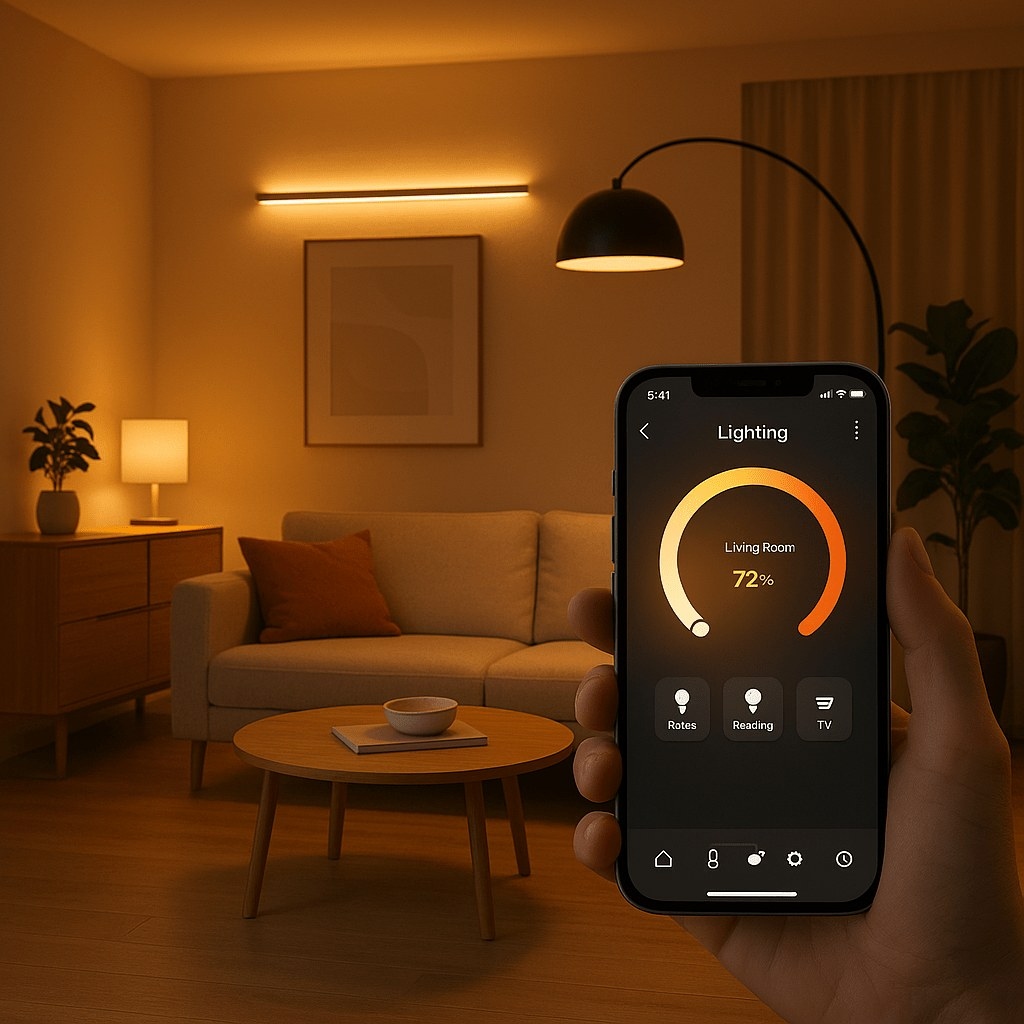
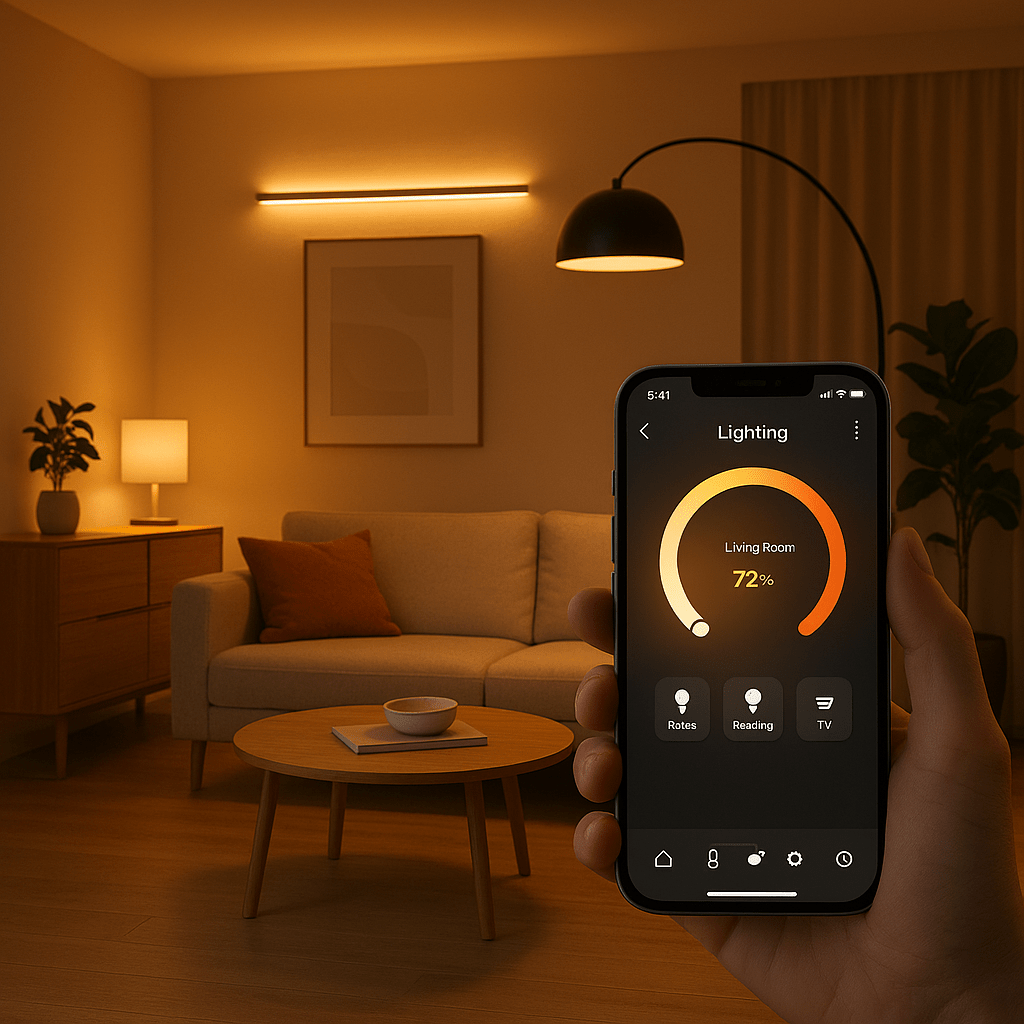
Smart home lighting design combines connected devices with established lighting principles to create spaces that respond to daily routines. Rather than simply replacing conventional bulbs, it brings together illumination, automation and personal preferences to support comfort, productivity, security and energy efficiency.
A successful design considers both what the technology can do and how light should function within a room. Sensors and automated controls can adjust illumination as conditions change, while thoughtful placement and layering keep the result practical and visually balanced.
How smart lighting systems work
A smart lighting system connects LED bulbs, sensors, automated controls, user interfaces and, where required, central control hubs through a home's wireless network. Together, these components determine when lights operate and how much illumination they provide. Smart LEDs offer adjustable colour temperatures and a broad range of colours as well as energy efficiency.
Wi-Fi, Zigbee, Z-Wave and the emerging Matter protocol provide communication between devices. Developed by the Connectivity Standards Alliance, Matter establishes a shared standard for interoperability across brands and platforms, allowing homeowners to combine devices from different manufacturers.
Wi-Fi 6 and 5G expand connectivity options with faster transfers, lower latency and better coverage. These improvements support reliable operation in large or densely populated areas and help lighting respond promptly to commands and environmental changes.
Motion sensors detect occupancy, while ambient light sensors measure available natural light. More advanced systems also use temperature sensing and sound detection to build a fuller picture of room conditions before adjusting illumination.
Lighting, daily rhythms and well-being
Lighting affects more than visibility. Scientific research links lighting conditions with circadian rhythms, mood, productivity and general well-being. Human-centric lighting (HCL) applies these relationships by changing intensity and colour temperature throughout the day to follow natural light patterns, supporting mood, productive activity and sleep quality.
Colour temperature is measured in Kelvin. Cool light at 5000K-6500K encourages alertness and concentration, making it suitable for workspaces and morning activities. Warm light at 2700K-3000K promotes relaxation and preparation for sleep.
Illuminance, or brightness, works alongside colour temperature. A dynamic system might gradually brighten with cool light to simulate sunrise, then become warmer and dimmer in the evening. Smooth transitions help lighting follow biological rhythms rather than remaining fixed all day.
Appropriate illumination can also reduce eye strain and fatigue. Task lighting supports detailed work, ambient lighting illuminates the room overall, and accent lighting draws attention to decorative or architectural features. Each layer has a different functional and psychological role.
Environmental psychology research associates greater personal control over lighting with higher satisfaction, less stress and improved quality of life. Custom scenes give users a way to match their surroundings to individual activities and preferences.
Energy use, running costs and sustainability
Smart lighting reduces unnecessary electricity consumption through efficient light sources and responsive controls. Lower energy demand also reduces greenhouse gas emissions and environmental impact.
LEDs use up to 80% less energy than traditional incandescent bulbs and last 25 times longer. Automation adds further savings by adapting operation to user behaviour and environmental conditions.
Schedules can gradually brighten lights for waking, dim them in the evening and switch them off in empty spaces. Motion and occupancy sensors reduce reliance on people remembering to use a switch; sophisticated versions distinguish passing movement from sustained occupancy.
In hallways, bathrooms and garages, where lights are often left on, motion-based control can cut energy consumption by 30-50%. Smart plug switches bring table lamps and other plug-in fixtures into the automation system, while energy monitoring devices reveal consumption patterns.
Automatic dimming responds to daylight, room activities and time of day, using only the brightness needed. Studies indicate that dimming by 10% can save approximately 10% in energy, with greater dimming producing proportionally larger savings.
Remote monitoring and real-time control help homeowners identify waste. Many systems also supply detailed energy reports, making it easier to adjust usage based on actual consumption.
Electricity savings can offset the initial investment: smart lighting typically pays for itself within 2-3 years, then continues delivering savings over its operating life.
For outdoor and security lighting, solar-powered systems collect daytime energy and store it in batteries for use at night, reducing dependence on grid electricity. Kinetic and thermal energy harvesting are also being incorporated to convert ambient energy into electrical power and improve overall efficiency.
Build a layered lighting design
Connected bulbs alone do not create a coherent lighting scheme. Effective design balances three layers—ambient, task and accent lighting—and uses smart controls to adjust them independently for different situations.
Ambient lighting
The base layer provides comfortable, even illumination for movement and general activities. It should avoid shadows and create a welcoming atmosphere. Automation can vary this light according to daylight, occupancy and time of day.
Task lighting
Focused light supports reading, cooking, working and grooming. Position sources to minimise glare and shadows while providing adequate illumination for the activity. Motion triggers in specific areas, voice commands and mobile apps can activate task lighting; smart switches and dimmer modules provide finer brightness control.
Accent lighting
Accent light gives a room visual interest by highlighting artwork, architecture or other focal points. Automated scenes might illuminate art during evening entertaining, emphasise architectural details at dinner parties or provide subtle pathways for night-time movement.
Colour, zones and architectural features
A daily colour-temperature programme can start with warm morning tones, move towards cooler light during active hours and return to warmth in the evening. Automation allows these changes to happen without manual adjustment.
Separate zones let each space serve its purpose: warm, dimmable light can prioritise comfort in living areas; bright, cool illumination can support concentration in a home office; and gentle, warm bedroom lighting can encourage relaxation before sleep.
Architectural lighting adds another dimension. Indirect cove lighting can make a space feel larger, while kitchen under-cabinet lighting supplies both task illumination and an accent. Coordinating these elements through shared scenes creates a consistent design.
Personalisation and advanced automation
Automation turns fixed lighting into an environment that responds to routines, preferences and seasonal changes. Artificial Intelligence and Machine Learning can learn from historical behaviour and usage, progressively anticipating preferred settings without manual intervention.
Custom scenes group settings around activities. A "Movie Night" scene might leave only subtle accents, while "Dinner Party" could use warm, inviting light. "Wake Up" can gradually raise brightness and shift colour temperature to imitate sunrise. Wall-mounted scene controllers activate these presets with one button press.
Amazon Alexa, Google Assistant and Apple Siri integration enables hands-free adjustments without an app or physical switch. More advanced voice control can interpret requests such as setting a living room to 30% brightness with warm white light, or activating movie mode in a basement.
Geofencing uses residents' locations to turn lights on as they approach and off when everyone leaves. More advanced implementations also choose scenes appropriate to the arrival time.
Connections with other home systems broaden the possibilities. Lighting can simulate occupancy alongside security systems, coordinate energy use with climate controls, or combine with audio and video for immersive entertainment.
Weather and seasonal programming compensate for shifts in daylight. Extra illumination during short winter days can help combat seasonal affective disorder, while summer settings can emphasise savings during peak demand periods.
Scheduling can extend beyond daily timers to programmes that vary by week, month or year. Different weekday and weekend routines, holiday effects and vacation occupancy simulations all fit within this approach.
Machine-learning-based predictive maintenance can anticipate bulb or fixture failure, allowing replacement before an unexpected outage. This is especially useful commercially, but also adds convenience at home.
Plan installation and ongoing operation
Implementation requires an assessment of the home's infrastructure, a suitable technology choice and an installation plan that limits disruption. Gradual deployment can spread costs while giving household members time to learn.
- Check electrical infrastructure first. Older properties may need upgrades, especially where switch boxes lack neutral wires or electrical panels are outdated. A professional assessment establishes whether the installation can safely and reliably support smart lighting.
- Choose the communication approach. Wi-Fi offers simplicity and broad compatibility, but many devices can strain a home network. Zigbee and Z-Wave require dedicated hubs, while offering reliable mesh networking and better battery life for battery-powered devices. Emerging Matter interoperability promises to simplify choices across technologies.
- Introduce the system in phases. Main living spaces and primary bedrooms can come first, followed by secondary rooms, outdoor lights and more advanced automation.
- Match installation support to complexity. Homeowners can install many smart bulbs, but hardwired switches, dimmers and integrated architectural lighting often benefit from professional installation for safety, performance and compatibility with existing wiring.
- Assess network coverage. Wi-Fi-based installations need reliable wireless service throughout the property. Mesh networking or additional wireless access points may be necessary.
- Help everyone learn the controls. Household members should understand voice commands, mobile apps and backup manual operation so they can use the system effectively.
- Establish maintenance routines. Plan software updates, wireless-device battery replacements and periodic optimisation. Even with automatic updates, users should know how to monitor system health and address problems.
- Plan wider integration. Consider current and future security, climate, entertainment and automation systems when developing the overall smart home strategy.
Emerging directions in smart lighting
New technologies are extending lighting beyond familiar bulbs and controls. Understanding these developments provides context for present choices and future expansion.
Immersive environments and new light sources
Augmented Reality (AR) and Virtual Reality (VR) integration can adapt physical lighting to virtual environments. Gaming, training simulations and virtual tours are potential applications, combining digital experiences with responsive surroundings.
Quantum Dot and OLED technologies promise better colour accuracy, energy efficiency and design flexibility. Ultra-thin, flexible and transparent panels could bring lighting into surfaces and objects that conventional fixtures cannot accommodate.
Data transmission and environmental sensing
Li-Fi (Light Fidelity) uses LEDs to transmit data. It could turn lighting into high-speed internet access points, potentially replacing separate Wi-Fi networks with secure data transmission through existing lighting infrastructure.
Future sensor combinations may include air quality measurement, biometric monitoring and health tracking. Lighting could respond to heart rate, stress or sleep patterns. Temperature and humidity sensors can already coordinate with lighting to support comfort and energy efficiency.
Predictive personalisation
Future AI systems are expected to combine individual behaviour with broader usage patterns, weather information and seasonal trends for more predictive control. Biometric identification through facial recognition, voice patterns or other identifiers may also let lighting automatically follow the preferences of different family members entering a room.
Connected communities and energy independence
Smart city applications extend coordinated lighting to urban areas, linking it with traffic management, public safety and environmental monitoring to improve efficiency, safety and quality of life.
Further advances in energy harvesting, battery storage and efficiency continue to shape sustainable lighting. More capable solar integration and storage may eventually allow systems to operate independently of external energy supplies.

